

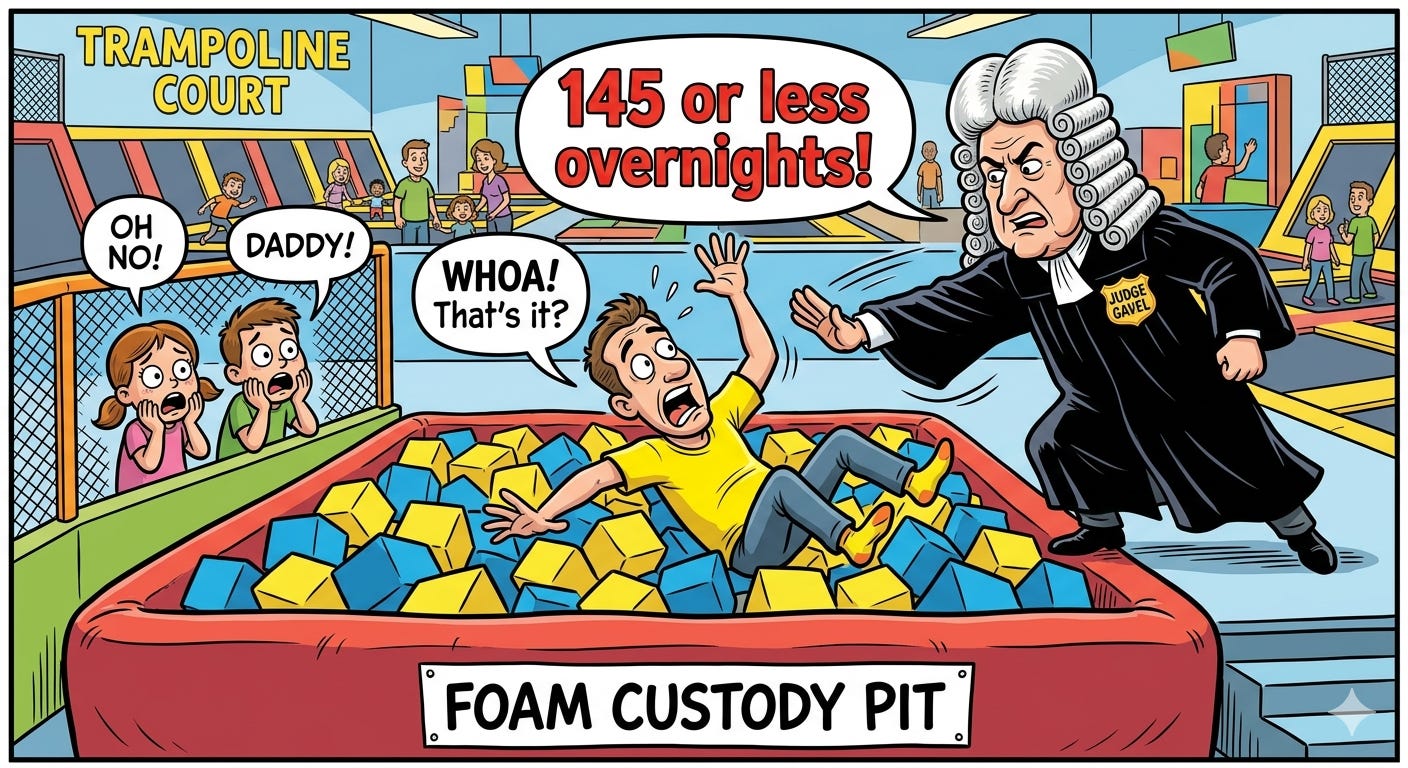
The Child Support Cliff: Systemic Mechanics, Multi-Jurisdictional Comparisons, and the Illinois Allocation Framework
The intersection of child support guidelines and physical parenting time schedules frequently produces a highly contentious phenomenon known as the child support cliff. Under standard income-shares models, child support is calculated using a formulaic schedule intended to mirror the economic expenditures of an intact household. However, rather than establishing a linear continuum where each additional overnight spent with a parent results in a small, incremental adjustment to the support obligation, many state guidelines employ sharp, arbitrary numerical thresholds. Crossing these thresholds triggers a sudden shift to an entirely different calculation methodology, resulting in a dramatic change in the support obligation. This structural design introduces significant financial volatility into family law proceedings, transforming child access arrangements into high-stakes financial disputes.
The Child Support Cliff Concept: Mechanics and Perverse Incentives
The core operational mechanism of the child support cliff lies in how state guidelines reclassify physical care arrangements. In a standard sole physical care model, child support calculations assume that the majority-time parent absorbs the vast majority of the child's fixed household expenses. The minority-time parent is ordered to pay a direct percentage of their income or a proportional share of the basic support schedule. However, once a parent's parenting time crosses a designated overnight threshold, the state's formula reclassifies the arrangement as "shared physical care".
This reclassification fundamentally alters the mathematical formula in two ways. First, the basic child support obligation is typically multiplied by a factor (often 1.5) to account for the duplicated fixed costs of maintaining two fully functional households for the child, such as housing, utilities, and bedrooms. Second, the parents' respective shared support obligations are cross-credited and offset based on the actual percentage of overnights each parent exercises. Because the offset formula aggressively discounts the obligation of the parent who pays support, crossing the threshold results in a precipitous drop in the transfer payment.
This binary system introduces highly perverse incentives into child custody negotiations and litigation. Parents frequently engage in intense legal battles over a single overnight not out of concern for the child's developmental needs, but to reach the mathematical target that triggers the shared care formula. This dynamic, often referred to in domestic relations litigation as a financial "cash grab," severely damages co-parenting relationships. Obligors are incentivized to demand parenting time they may not actually exercise, while obligees are incentivized to restrict access to protect their primary financial support. The resulting litigation clogs family court dockets and forces judges to evaluate whether parenting schedules are driven by genuine parental bonding or mathematical targets.
Multi-Jurisdictional Analysis and Statutory Thresholds
The severity of the cliff effect varies widely across the United States, depending on the specific overnight thresholds and the presence of legislative smoothing mechanisms. While some states maintain rigid, unyielding cliffs, others have recognized the systemic dysfunction these thresholds cause and have implemented graduated or continuous formulas to eliminate or mitigate the sudden financial drop.
The following table represents the baseline overnight thresholds required to trigger a shared physical custody child support calculation across all fifty states, compiled from statutory reviews and widely cited family court directories. It is critical to note that while some states maintain these rigid baselines, others have recently amended their statutory guidelines to smooth or entirely eliminate the cliff effect.
State
Baseline Shared Care Threshold (Annual Overnights)
Statutory Basis / Current Policy Status
Alabama
N/A
No standard parenting-time adjustment threshold.
Alaska
N/A
No standard parenting-time adjustment threshold.
Arizona
62 overnights
Baseline threshold is 62 overnights.
Arkansas
141 overnights
High threshold is 141 overnights.
California
109 overnights
Under Cal. Fam. Code § 3040, the baseline is 109 overnights.
Colorado
92 overnights
Historically 92 overnights ; C.R.S. § 14-10-115 was overhauled effective March 1, 2026, to implement a continuous graduated formula starting at the first overnight.
Connecticut
N/A
No standard parenting-time adjustment threshold.
Delaware
143 overnights
High threshold is 143 overnights.
Florida
73 overnights
Threshold is 73 overnights.
Georgia
128 overnights
Threshold is 128 overnights.
Hawaii
N/A
No standard parenting-time adjustment threshold.
Idaho
109 overnights
Threshold is 109 overnights.
Illinois
146 overnights
High threshold is 146 overnights under 750 ILCS 5/505.
Indiana
109 overnights
notes some parenting time credits begin at 51 overnights, but a full shared calculation is cited at 109.
Iowa
128 overnights
Threshold is 128 overnights (35% of the year).
Kansas
128 overnights
Threshold is 128 overnights (35% of the year).
Kentucky
128 overnights
Threshold is 128 overnights.
Louisiana
109 overnights
Threshold is 109 overnights.
Maine
109 overnights
Threshold is 109 overnights.
Maryland
109 overnights
Historically 128 overnights ; amended in October 2020 to establish a 92-overnight baseline (25%) with a transitional adjustment up to 109 overnights.
Massachusetts
N/A
No standard parenting-time adjustment threshold.
Michigan
128 overnights
Threshold is 128 overnights.
Minnesota
109 overnights
Threshold is 109 overnights.
Mississippi
N/A
No standard parenting-time adjustment threshold.
Missouri
92 overnights
Threshold is 92 overnights.
Montana
109 overnights
Threshold is 109 overnights.
Nebraska
128 overnights
Threshold is 128 overnights.
Nevada
109 overnights
Threshold is 109 overnights.
New Hampshire
128 overnights
Threshold is 128 overnights.
New Jersey
N/A
No standard parenting-time adjustment threshold.
New Mexico
128 overnights
Threshold is 128 overnights.
New York
N/A
No standard parenting-time adjustment threshold.
North Carolina
128 overnights
Threshold is 128 overnights.
North Dakota
109 overnights
Traditional baseline is 109 overnights; notes full reduction triggers at 164 overnights.
Ohio
109 overnights
Threshold is 109 overnights.
Oklahoma
109 overnights
Threshold is 109 overnights.
Oregon
91 overnights
Threshold is 91 overnights.
Pennsylvania
109 overnights
Threshold is 109 overnights.
Rhode Island
N/A
No standard parenting-time adjustment threshold.
South Carolina
109 overnights
S.C. Code Regulations § 114-4730 applies Worksheet C at 110 overnights, with a graduated adjustment starting at 110 overnights.
South Dakota
109 overnights
Threshold is 109 overnights.
Tennessee
92 overnights
Requires more than 92 overnights (93 nights) for sliding scale adjustment.
Texas
109 overnights
Threshold is 109 overnights.
Utah
109 overnights
Threshold is 109 overnights.
Vermont
128 overnights
Threshold is 128 overnights.
Virginia
91 overnights
Requires more than 90 days (91 days) to trigger shared custody calculation.
Washington
91 overnights
Threshold is 91 overnights.
West Virginia
128 overnights
Requires more than 127 days (128 days) to trigger shared custody calculation.
Wisconsin
92 overnights
Threshold is 92 overnights.
Wyoming
109 overnights
Threshold is 109 overnights.
Legislative Pathward to Cliff Mitigation: Colorado, Maryland, and South Carolina
The legislative histories of several states show a growing trend toward smoothing or eliminating these steep thresholds to lower the emotional temperature of custody cases.
Colorado's family law system provides a modern example of complete cliff elimination. Historically, Colorado maintained a rigid 93-overnight threshold. Parents who had 92 overnights received zero credit for parenting time, while those who reached 93 overnights shifted to Worksheet B and received a substantial reduction in child support via a 1.5 multiplier. Effective March 1, 2026, the Colorado Legislature enacted a comprehensive overhaul under C.R.S. § 14-10-115, replacing the dual-worksheet system with a single graduated formula. Under this new continuous formula, parenting-time credits begin at the very first overnight and scale linearly to a 50/50 arrangement (182 overnights). This continuous adjustment has eliminated the mathematical incentive to fight over specific thresholds.
Maryland has taken a tiered approach to address the cliff effect. For years, Maryland operated with a severe cliff at 128 overnights per year. If a parent had 127 overnights, they were assessed under a "sole physical custody" worksheet, but gaining just one more overnight triggered the "shared physical custody" worksheet, resulting in a sudden and massive drop in support payments. In October 2020, Maryland lowered the shared custody threshold to 92 overnights (25% of the year) and implemented a transitional mathematical adjustment between 92 and 110 overnights. The full shared physical custody guidelines are only applied when each parent has more than 110 overnights, which has successfully softened the cliff into a gentler slope.
South Carolina utilizes a dual-worksheet system to manage its 110-overnight (30%) shared custody threshold under S.C. Code Regulations § 114-4730. To prevent a severe cliff for parents hovering near the threshold, the state applies a "graduated support obligation" for arrangements between 110 and 127 overnights. The court calculates both the standard sole custody obligation using Worksheet A and the full shared physical custody obligation using Worksheet C. The final graduated obligation is determined by executing the following calculation:
This graduated formula smooths the transition, ensuring that child support decreases incrementally as parenting time increases within the 110-to-127 overnight range.
The Illinois Child Support Framework and the 146-Overnight Threshold
Illinois child support guidelines are governed by an Income Shares Model, implemented in 2017, which combines both parents' net incomes to determine a basic child support obligation. This basic obligation is derived from a standardized schedule provided by the Illinois Department of Healthcare and Family Services (HFS), which reflects average child-rearing expenditures in the state.
Standard Calculation (Under 146 Overnights)
In standard arrangements where one parent has the child for fewer than 146 overnights annually, child support is calculated using a straightforward allocation of the basic support obligation.
Step 1: Determine each parent's net income by applying standardized gross-to-net tax conversion tables to their gross incomes.
Step 2: Combine both parents' net incomes to find the total family net income.
Step 3: Locate the Basic Child Support Obligation (BCSO) on the HFS Income Shares Schedule based on the combined net income and the number of minor children.
Step 4: Calculate each parent's percentage share of the combined net income.
Step 5: Allocate the BCSO proportionally. The parent with the majority of parenting time (the obligee) is presumed to spend their share directly on the child. The parent with less parenting time (the obligor) is ordered to pay their share directly to the obligee :
Extraordinary expenses, such as work-related childcare, health insurance premiums, and outstanding school or extracurricular costs, are also divided proportionally according to the income share percentages and added to the final monthly transfer order.
Shared Care Calculation (146 or More Overnights)
When each parent exercises 146 or more overnights per year (representing at least 40% of the year), the child support formula shifts to a "shared physical care" model. This threshold triggers a cross-credit calculation that factors in the overnights spent in each household.
Step 1: Multiply the BCSO by 1.5 to establish the Shared Care Support Obligation (SCSO), accounting for duplicated household costs :
Step 2: Determine each parent's theoretical share of the SCSO based on their percentage share of the combined net income.
Step 3: Multiply each parent's theoretical obligation by the percentage of overnights spent with the other parent. This step mathematically reflects the assumption that a parent is directly supporting the child when the child is in their physical care.
Step 4: Offset the final obligations. The parent with the larger obligation pays the net difference to the parent with the lower obligation :
Mathematical Analysis of the Illinois Cliff
To illustrate the financial impact of the 146-overnight threshold, consider a family with two children. Parent A (the obligor) earns 70% of the combined net income, and Parent B (the obligee) earns 30%. The combined net monthly income is $5,500. According to the HFS schedule, the basic child support obligation (BCSO) for two children at this income level is $1,521.
Scenario A: Standard Calculation (145 Overnights)
If Parent A exercises 145 overnights (just under the 40% threshold), the standard calculation applies. Parent A's monthly child support payment is calculated as:
#### Scenario B: Shared Care Calculation (146 Overnights) If Parent A gains just one additional overnight, reaching the 146-overnight threshold, the shared care formula is triggered. The calculation steps are as follows:
Calculate the SCSO:
Allocate the SCSO by income share:
Parent A's share: 2,281.50 \times 0.70 = 1,597.05
Parent B's share: 2,281.50 \times 0.30 = 684.45
Factor in the parenting timeshare percentages (assuming Parent A has exactly 146 overnights, which is 40% of the year, and Parent B has 219 overnights, or 60%):
Parent A's final theoretical obligation: 1,597.05 \times 0.60 = 958.23
Parent B's final theoretical obligation: 684.45 \times 0.40 = 273.78
Offset the obligations:
#### Comparative Financial Analysis
Metric
Standard Formula (145 Overnights)
Shared Care Formula (146 Overnights)
Net Variance
Parent A's Monthly Payment
$1,064.70
$684.45
-$380.25
Parent A's Annual Obligation
$12,776.40
$8,213.40
-$4,563.00
As this comparison demonstrates, the transition of a single overnight—from 145 nights to 146 nights—triggers a sudden drop of $380.25 per month, representing a 35.7% reduction in child support. This steep drop occurs because the formula assumes both parents are absorbing duplicate household costs, even though the actual difference in care is just one night. In high-income cases (such as combined parental incomes near the guideline cap), this threshold crossing can result in drops of thousands of dollars per month. This financial reality creates a powerful incentive for parents to engage in aggressive, high-conflict litigation over parenting time.
The Allocation of Parental Responsibilities and Parenting Time under Illinois Law
The child support cliff operates within a broader legal framework that governs parenting time and decision-making in Illinois. In 2016, the Illinois Marriage and Dissolution of Marriage Act (IMDMA) underwent a major revision that replaced the traditional concept of "custody" with two distinct legal categories: the "Allocation of Parental Responsibilities" and "Parenting Time". This change was designed to reduce the adversarial, winner-take-all nature of traditional custody battles.
The Allocation of Parental Responsibilities (Decision-Making)
Under 750 ILCS 5/602.5, parental responsibilities represent the authority to make significant, long-term decisions on behalf of a minor child. This authority is divided into four distinct statutory categories:
Education: Choice of schools, enrollment, tutors, and special educational services.
Health: Non-emergency medical, dental, and psychological treatments.
Religion: Religious upbringing, participation in religious activities, and spiritual education.
Extracurricular Activities: Sports, arts programs, camps, and developmental activities.
The court can allocate decision-making authority jointly, divide it by category, or grant sole authority to one parent. If parents show a high level of conflict or an inability to communicate effectively, the court will typically allocate sole decision-making authority to one parent to prevent gridlock.
The Allocation of Parenting Time
Parenting time refers to the actual physical schedule during which a parent is responsible for the care and daily routines of the child. Under 750 ILCS 5/602.7, parents must submit a proposed parenting plan to the court within 120 days of filing a petition for allocation of parental responsibilities. If the parents reach an agreement, they enter a Parental Allocation Judgment (PAJ), which the court will approve if it is consistent with the child's best interests. If the parents cannot agree, the court will order mediation. If mediation fails, the court will conduct an evidentiary hearing and allocate parenting time based on the child's best interests.
Statutory Best Interest Factors (750 ILCS 5/602.7(b))
In determining the best interests of the child for allocating parenting time, the court must evaluate all relevant factors, including:
The wishes of each parent seeking parenting time.
The wishes of the child, taking into account their maturity and ability to express independent preferences.
The amount of time each parent spent performing caretaking functions in the 24 months preceding the filing of the petition.
Any prior agreement or course of conduct between the parents relating to caretaking functions.
The interaction and interrelationship of the child with parents, siblings, and other significant individuals.
The child's adjustment to their home, school, and community.
The mental and physical health of all individuals involved.
The child's needs.
The distance between the parents' residences, transport logistics, and the parents' ability to cooperate.
Whether a restriction on parenting time is appropriate due to physical, mental, moral, or emotional endangerment.
Any physical violence or threats of physical violence directed against the child or household members.
The willingness and ability of each parent to place the child's needs ahead of their own.
The willingness and ability of each parent to facilitate and encourage a close, continuing relationship between the other parent and the child.
The occurrence of abuse against the child or other household members.
Whether either parent is a convicted sex offender or lives with one.
The terms of a parent's military family-care plan.
The court is explicitly prohibited from considering parental conduct that does not affect the parent's relationship with the child. In high-conflict cases, the court will closely evaluate the parents' willingness to facilitate a close relationship with the other parent. A parent who engages in obstructive or uncooperative behavior during parenting exchanges can fail this factor, which may lead the court to restrict their parenting time or allocate sole decision-making authority to the other parent.
Practical Implementation Mechanisms
In addition to the best interest factors, Illinois law incorporates several practical mechanisms to manage parent-child contact and resolve disputes:
The Right of First Refusal: Under 750 ILCS 5/602.3, parenting plans may include a provision requiring a parent who needs childcare for a designated period (e.g., several hours or overnight) to first offer the other parent the opportunity to care for the child before hiring an outside caregiver or utilizing a babysitter. This mechanism encourages maximum parental involvement and reduces third-party care costs.
Restrictions on Parenting Time (750 ILCS 5/603.10): The baseline presumption under Illinois law is that both parents are fit. To restrict a parent's time—such as ordering supervised visitation or prohibiting overnight contact—the court must find by a preponderance of the evidence that the parent's un-restricted parenting time would "seriously endanger" the child's physical, mental, moral, or emotional health.
Modification and the Two-Year Bar (750 ILCS 5/610.5): To maintain family stability, Illinois law implements a strict two-year ban on modifying the allocation of parental decision-making responsibilities. Exceptions are only granted if the court finds a serious threat of endangerment, a minor modification, mutual agreement, or a de facto arrangement that the parents have voluntarily followed for at least six months.
Procedural and Local Rules: The 18th Judicial Circuit of DuPage County
While state statutes establish the substantive legal framework, local circuit court rules dictate the procedural path family law litigants must follow. In Illinois, local rules can significantly impact how financial and parenting issues are managed, as illustrated by the local rules of the Eighteenth Judicial Circuit in DuPage County (Wheaton, Illinois).
Discovery and the Sworn Financial Affidavit
Under DuPage County Local Rule 15.05, family court litigants face strict discovery timelines designed to prevent delays. Within thirty days of the defendant filing a general appearance or first responsive pleading, both parties must complete and serve a Comprehensive Financial Statement supported by corroborating documents, including federal income tax returns, recent pay stubs, and banking statements.
If a party files a motion for temporary support before this thirty-day period expires, they must serve a preliminary Comprehensive Financial Statement contemporaneously with their motion to ensure the court has immediate access to verified financial data. These discovery rules apply equally to post-judgment financial modification proceedings, ensuring that any proposed modification of spousal maintenance or child support is built on complete financial disclosure.
Mandatory Parenting Education
DuPage County strictly enforces parenting education requirements to prepare parents for post-divorce co-parenting.
Parentage (FA) Cases: Under Local Rule 15.05(b), in all parentage cases involving a minor child, both parents must complete the Parents and Kids (PAK) Program as soon as possible, but no later than sixty days after the initial status conference.
Dissolution (DC) Cases: Under Local Rule 15.05(c), divorcing parents must complete the Caring, Coping, and Children (CCC) Program within sixty days of the initial status conference.
The court will not excuse a parent's attendance from these programs unless it documents a specific finding in the record that excusing them serves the child's best interests.
Electronic Prove-Ups and Mandatory Judgment Provisions
Under Administrative Order 24-4, DuPage County has established an electronic review process for agreed judgments, provided specific procedural safeguards are met. Litigants can submit proposed Marital Settlement Agreements (MSAs) and Parental Allocation Judgments (PAJs) electronically for judicial review, but must comply with the following strict standards:
Entry of Judgment Continuation (Rule 15.20): If proofs are closed at a prove-up but a final judgment is not entered that day, the case must be continued to a date certain not to exceed six weeks for the final entry of judgment. If counsel fails to present the judgment within this period, the court may require an affidavit explaining the delay; outstanding attorney's fees are explicitly rejected as a valid excuse.
Agreed Parenting Plans: Agreed PAJs must contain all state-mandated clauses, including a detailed dispute resolution and mediation provision, to be presumed consistent with the child's best interests.
Detailed Calculation and Deviation Disclosures: Proposed MSAs that establish child support or maintenance must explicitly reference the statutory formula used (the income-shares model). If the parties agree to deviate from or waive child support, the agreement must clearly detail the legal and factual basis for the deviation.
The Prove-Up Affidavit: Both parties must sign and submit a comprehensive, notarized affidavit confirming that the court has jurisdiction, they voluntarily enter into the agreement without coercion, they believe the property division is fair, and they waive their physical presence in court and the right to cross-examination.
Narrative Synthesis and Policy Outlook
The child support cliff remains a significant structural challenge in the family law systems of Illinois and several other states. While the transition to income-shares models in states like Illinois was a major step toward reflecting the dual-income nature of modern households, the reliance on sharp parenting time thresholds continues to incentivize high-conflict litigation and distort parenting schedules.
Comparing Illinois' rigid 146-overnight threshold with the legislative shifts in Maryland and Colorado highlights clear pathways for policy reform. Colorado's transition in March 2026 to a single, continuous graduated formula under C.R.S. § 14-10-115 represents a leading-edge approach to addressing this issue. By providing parenting-time credits starting from the very first overnight, the continuous model eliminates the sudden financial drops that drive strategic litigation. Similarly, South Carolina's graduated mathematical adjustment for parents hovering near the shared custody threshold demonstrates how dual-worksheet systems can be softened to prevent severe financial drops.
For states like Illinois that maintain a sharp, binary threshold, implementing a graduated or continuous adjustment would align family court calculations with the developmental needs of children. By smoothing the child support curve, state legislatures can reduce the financial incentives that drive parents into high-conflict custody battles. This reform would allow parents, attorneys, and judges to focus on creating schedules that truly support the child's emotional and physical well-being, rather than navigating artificial mathematical targets.
Works cited
1. Child Support Cliff- State Financial Gain.docx, https://drive.google.com/open?id=1506xmV4jlvY4tyMCnliAUn250VZjmk4M 2. Child Support Cliff: State Financial Gain, https://drive.google.com/open?id=13Sdsm_z_AeHm2hFMrhl2DGd6IFg6rGwWvd79E6rPnb4 3. Child Support | DuPage County Family Law Lawyer Law Offices of Michael F. Roe LLC, https://www.illinois-attorney.net/practice-areas/child-support/ 4. Family Attorney in DuPage County, IL | Hanauer Law, https://www.hanauerlaw.com/dupage-county/family-law/ 5. Child Support Calculator: Income Shares Model | Dolci Weiland & Sendlak, https://www.dolciandweiland.com/resources/child-support-calculator/ 6. Illinois Child Support Laws & Calculator (2026 Guide) - Vantage Group Legal Services, https://vantagegl.com/illinois-child-support-law/ 7. Recent Maryland Child Support Changes | Stein Sperling, https://steinsperling.com/2020-maryland-child-support-changes/ 8. What Judges Secretly Hate Seeing In Divorce Cases - Merel Family Law, https://merelfamilylaw.com/blog/what-judges-secretly-hate-seeing-in-divorce-cases/ 9. Child Support | DuPage County Family Law Lawyers Kollias & Conner, P.C, https://www.dupageattorneys.net/practice-areas/child-support/ 10. Child Support and Divorce in Illinois | Sterling Lawyers, LLC, https://www.sterlinglawyers.com/illinois/child-support/divorce/ 11. Colorado's New Child Support Formula Eliminates 93-Overnight Cliff, Raises Cap to $40K, https://divorce.law/guides/news/colorado-child-support-overhaul-93-overnight-cliff-eliminated-march-2026/ 12. Eliminating the Cliff: Maryland's New Child Support Guidelines - Tydings, https://www.tydingslaw.com/news-insights/eliminating-cliff-marylands-new-child-support-guidelines 13. Maryland Child Support Guidelines Updates – Shared Physical Custody 2020, https://lindsayparvis.com/maryland-child-support-guidelines-updates-shared-physical-custody-2020/ 14. Client Update – Change to Maryland Child Support Laws - Bulman Dunie, https://www.bulmandunie.com/blog/2021/02/client-update-change-to-maryland-child-support-laws/ 15. Changes to Child Support Laws in 2020 - BGS Law, LLC, https://bgslawllc.com/changes-to-child-support-laws-in-2020/ 16. S.C. Code Regs. § 114-4730 - Unusual Custody Arrangements | State Regulations - Law.Cornell.Edu, https://www.law.cornell.edu/regulations/south-carolina/R-114-4730 17. Parenting Time Calculator for South Carolina Divorces | 2026, https://divorce.law/tools/parenting-time-calculator/south-carolina/ 18. Illinois Child Support Estimator - HFS, https://cscwebext.hfs.illinois.gov/CscWebEx/app/estimator 19. Child Support Attorneys Chicago - Child Support Lawyers Illinois - Katz & Stefani, LLC, https://www.katzstefani.com/practice-areas/child-support-attorney-chicago/ 20. Child Custody in Illinois: What Parents Need to Know - Weiss Ortiz, https://www.weissortizlaw.com/child-custody-in-illinois-what-parents-need-to-know 21. Child Custody Lawyer Near Joliet - Sabuco Beck, P.C., https://sabucobeck.com/our-services/family/child-custody/ 22. Parental Responsibilities: What Replaced “Custody” and Why It Matters, https://khk.law/blog/parental-responsibilities-what-replaced-custody-and-why-it-matters/ 23. Recent Changes to Illinois Family Law 2025 - O'Flaherty Law, https://www.oflaherty-law.com/learn-about-law/recent-changes-to-illinois-family-law 24. Divorce Attorney in Wheaton, IL | Hanauer Law, https://www.hanauerlaw.com/wheaton/family-law/divorce/ 25. High-Conflict Custody in Illinois - Sterling Lawyers, LLC, https://www.sterlinglawyers.com/illinois/child-custody/high-conflict-custody/ 26. Can Diverse Parental Religious Beliefs Affect Child Custody? | IL - MKFM Law, https://www.mkfmlaw.com/blog/can-diverse-parental-religious-beliefs-affect-child-custody-il 27. Can a Child Choose Which Parent to Live With in Illinois? | O. Long Law, LLC, https://olonglaw.com/blog/can-child-choose-parent-to-live-with/ 28. Candice Adams - e-filed in the 18th Judicial Circuit Court - DuPage County, https://cms5.revize.com/revize/dupage/Document_Center/Elected%20Officials/Administrative%20Orders/2024/AO%2024-4.pdf 29. 750 ILCS 5/602.7 - ILGA.gov, https://www.ilga.gov/documents/legislation/ilcs/documents/075000050K602.7.htm 30. ARTICLE 15: DOMESTIC RELATIONS, https://cms5.revize.com/revize/dupage/Document_Center/Elected%20Officials/%2018th%20Judicial%20Circuit%20Court/Local%20Court%20Rules/3-15.%20Domestic%20Relations_locked.pdf 31. RULE CHANGES – 7/16/08, https://cdn.ymaws.com/www.dcba.org/resource/resmgr/court_rule_amendments/court-rule-amendment-7-16-08.pdf 32. 750 ILCS 5/ Illinois Marriage and Dissolution of Marriage Act., https://www.ilga.gov/legislation/ILCS/details?MajorTopic=RIGHTS%20AND%20REMEDIES&Chapter=FAMILIES&ActName=Illinois%20Marriage%20and%20Dissolution%20of%20Marriage%20Act.&ActID=2086&ChapterID=59&ChapAct=750+ILCS+5%2F&SeqStart=6200000&SeqEnd=8675000 33. 750 ILCS 5/501, https://www.ilga.gov/documents/legislation/ilcs/documents/075000050k501.htm
BARinvestigation.com


